Personal Style as Self-Expression: Inside the Mind of a Dia Stylist
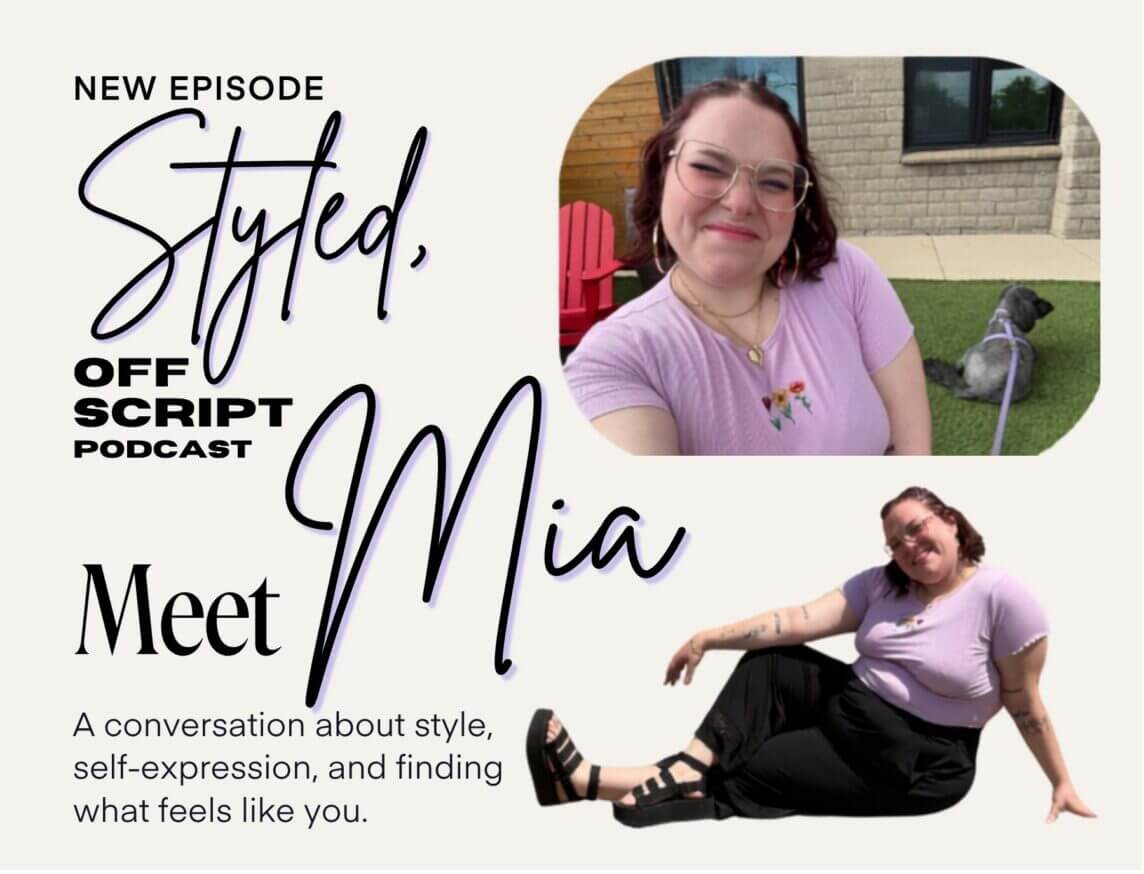
This week on Styled, Off Script, we’re joined by Dia stylist Mia for a conversation about personal style as self-expression, and the winding journey of figuring out who you are through clothes.
From community theater and alternative fashion to styling thousands of Dia customers, Mia shares how their personal style has evolved over the years—and why some of the most meaningful style discoveries happen when we’re willing to experiment, take risks, and try something unexpected.
Along the way, we talk about what it’s really like to be a stylist, how style can become a tool for confidence and self-expression, and why the best outfits aren’t necessarily the trendiest—they’re the ones that feel most like you.
🎧 Listen below, on Spotify, Apple Podcasts, iHeart, Amazon, or read the full transcript further down this page.
How Personal Style Becomes Self-Expression
Personal style as self-expression is less about finding one perfect aesthetic and more about discovering how you want to show up.
For Dia stylist Mia, clothes have always been part of that discovery. Their style has moved through childhood fashion experiments, scene and emo influences, a very 2010s blazer era, community theater, mime, and eventually back toward the alternative style that feels most natural today.
Mia describes their current style as soft goth: plenty of black, leather, platform shoes, unexpected textures, and pieces that balance something playful with something a little harder. But the label is only part of the story.
What makes an outfit feel like Mia is not necessarily the individual item. It is how everything comes together.
A black T-shirt can be simple on its own. Layer it over a slip dress, add fishnets, platform Mary Janes, and iridescent butterfly clips, and it becomes something completely different. The clothes are familiar; the point of view is personal.
That is what makes style such a powerful form of expression. The same dress, shirt, or pair of pants can communicate something entirely different depending on who is wearing it and how they make it their own.
Personal style does not have to fit neatly into one category, either. You can be soft goth at a concert, elevated camp counselor while running errands, and something else entirely tomorrow. An aesthetic can offer inspiration without becoming another set of rules.
The goal is not to dress so that everyone else immediately understands the reference. It is to create an outfit that feels connected to you.
Sometimes that begins with one piece: the boots that make you stand a little taller, the jacket that gives an easy outfit some edge, or the dress you keep finding new ways to wear.
Eventually, those experiments stop feeling like costumes.
They become your clothes.
What Does a Personal Stylist Actually Do?
A personal stylist does much more than choose clothes they personally find stylish.
In fact, one of the most important parts of the job is learning to set their own taste aside.
When Mia styles a Dia customer, they are not building a box for someone who lives Mia’s life, shares Mia’s preferences, or wants to dress exactly like Mia. They are interpreting another person’s needs.
Where are they going? What does an average day look like? Which colors do they reach for? What silhouettes feel familiar? What has worked before? What are they curious about trying next?
A piece that seems unremarkable to one person may be exactly what someone else has been looking for. Mia describes the satisfaction of finding an item that connects with pieces a customer already owns and reflects the style the two of them have developed together over multiple boxes.
That is where styling begins to feel a little like treasure hunting.
The stylist is looking beyond what an item appears to be on its own and imagining what it could become in someone else’s wardrobe.
That process requires practical knowledge of fit, color, proportion, and styling—but it also requires empathy. A stylist has to temporarily step into someone else’s life and consider how clothing needs to function within it.
A teacher who spends the day sitting on the floor with young children needs something different from a person working remotely at a desk. Someone dressing for a new job may need something different from someone rebuilding their everyday wardrobe after a major life change.
The stylist’s role is not to decide which person is doing style correctly.
It is to listen closely enough to help each person find clothes that work for the life they are actually living. As Mia puts it in the episode, styling can become a joyful experiment in empathy: a chance to see the world briefly through someone else’s closet.
Why Trying Something Unexpected Can Change Your Closet
Most of us are very good at choosing versions of what we already own.
We reach for the same silhouettes, colors, and combinations because they feel safe. We know how they work, and we know how we will feel in them.
Trying something completely different can feel surprisingly vulnerable.
What happens when you choose the bold color, unfamiliar pant shape, or dress you never pictured yourself wearing—and it does not work? It is easy to turn one unsuccessful outfit into a judgment about your body, taste, or ability to understand style.
Working with a stylist can lower the stakes.
When someone who understands your preferences suggests an unexpected piece, it becomes an invitation rather than a test. You can try it, see what happens, and decide how you feel without needing the experiment to prove anything.
Sometimes the stylist takes a risk and misses. The color is wrong. The fabric feels uncomfortable. The silhouette does not fit the way you hoped.
That information still matters.
Knowing why something did not work brings you closer to understanding what will. It gives both you and your stylist a more precise picture of your preferences—and makes the next choice more informed.
And sometimes the risk works beautifully.
An item you would have passed over becomes the piece that makes you feel especially confident. A new silhouette changes how you see the other clothes in your closet. One unexpected choice opens the door to several new outfits.
The value is not simply that a stylist may find something you would not have chosen.
It is that the experience can make trying feel less intimidating and help you become more confident in your own decisions.
How Dia Stylists Help You Find What Feels Like You
A successful relationship with a stylist is not usually built through one perfectly chosen box.
It develops through conversation.
At Dia, customers can share feedback on every item they receive—whether they keep it or send it back. That feedback helps a stylist understand not only what worked, but why.
“I did not like this” is a starting point.
“I did not like the stiff fabric, but I loved the color and neckline” offers a much clearer direction. So does explaining that a pair of pants fit well but did not work with the shoes you wear most, or that a top looked good but did not feel appropriate for your everyday life.
There is no expectation that you will love every piece. Having an opinion is part of the process.
Your preferences may change, too. A silhouette you once avoided may start to feel interesting. A color you regularly requested may no longer feel like you. Your work, routines, body, relationships, and confidence can all influence what you want from your wardrobe.
The conversation evolves because personal style evolves.
Liz describes the connection between a Dia stylist and customer as a kind of fashionable pen-pal relationship. The stylist sends a box and personalized note; the customer responds through ratings, written feedback, and future requests. Over time, those exchanges create trust and give the stylist a richer understanding of the person behind the profile.
That relationship can be useful whether you already have a strong personal style or feel unsure where to begin.
A stylist can bring a fresh perspective to a wardrobe you know well, help you articulate preferences you have never put into words, or simply suggest one new idea you might not have considered alone.
The goal is not to turn you into a version of your stylist.
It is to help you recognize more possibilities for yourself.
A Little Mia, A Lot of You
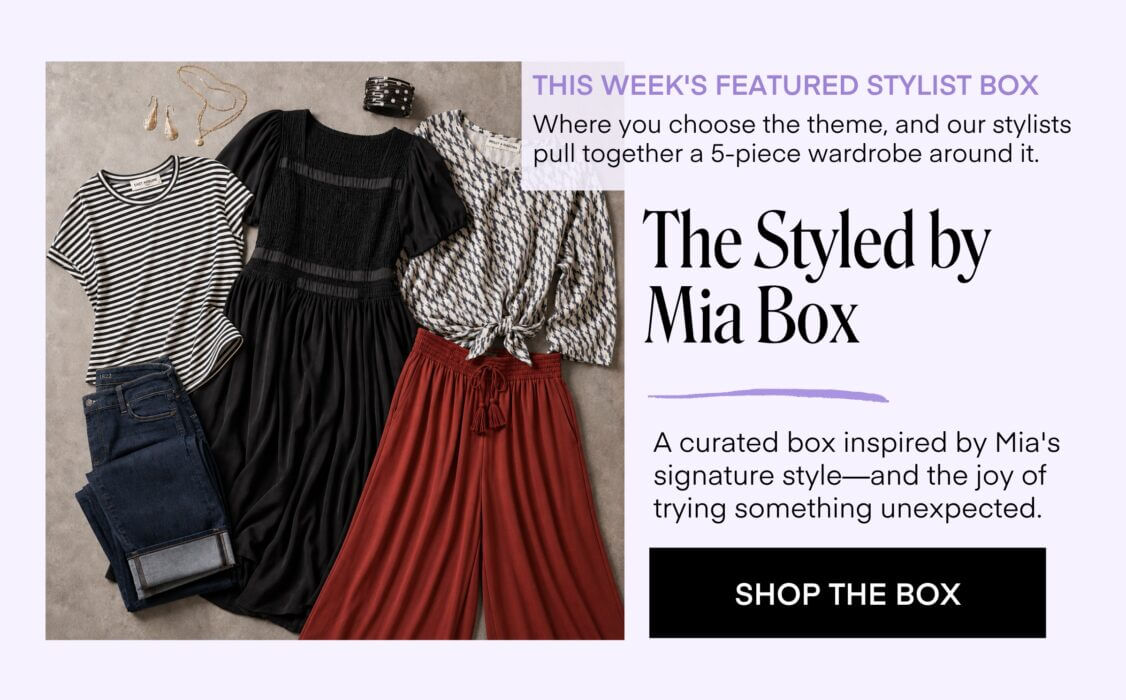
That same philosophy shapes the Styled by Mia Box.
Mia brings their eye for texture, black, dresses, accessories, and playful combinations—but each box is still styled for the individual receiving it. It is not a collection of five pieces Mia would wear. It is a meeting point between Mia’s creative perspective and the customer’s preferences, needs, and everyday life.
You choose the occasion or share what you are looking for, and Mia pulls together a five-piece wardrobe around it, complete with a personalized styling note.
The result might introduce a little more edge, an unexpected texture, or a piece you would not have noticed on your own.
But it should still feel like your closet.
Just with a new possibility inside it.
✨ This Week’s Feature
Instead of tackling a 🆘 Style Emergency this week, we’re celebrating the return of one of our most-requested stylist experiences: the Styled by Mia Box.
Inspired by Mia’s signature approach to styling—equal parts creativity, confidence, texture, and personal style as self-expression—this curated box is designed to help you discover new pieces, experiment with your style, and maybe even find something you never would have picked for yourself.
Because sometimes the best style discoveries happen when someone else sees a little bit of magic in a piece before you do.
Got a style dilemma?
We’re taking real SOS submissions for future episodes.
Whether you’re:
- packing for a trip
- stuck in a style rut
- navigating a wardrobe change
- or just not sure what to wear
Submit your own SOS request and we may feature it on the show!
Listen to Episode 5: Send in the Clowns
In Episode 5 of Styled, Off Script, Marge and Liz sit down with longtime Dia stylist Mia to talk about personal style as self-expression, soft-goth inspiration, the community-theater-to-fashion pipeline, and what it really means to dress another person.
They explore the pieces that help us feel powerful, the vulnerability of trying something new, the importance of customer feedback, and why personal styling is ultimately less about clothes than it is about connection.
Plus: the boots that changed everything, a strong case for jumpsuits, and considerably more mime conversation than you may have expected from a fashion podcast.
Click for the Full Episode 5 Transcript.
Marge We are officially recording episode five. That feels exciting. Woohoo. I don’t know if it’s officially a habit yet. I think a habit-forming thing has to be at least twelve. But recording five episodes feels like a milestone.
Liz Hello.
Mia Hooray!
Liz Okay. I agree.
Mia Yeah.
Marge Yeah, okay, cool. So I am Marge and I am joined by my co-host Liz. And we have a guest today, Mia.
Mia Hi.
Liz This is our first official guest.
Marge Yes. We can’t tell Maloree that. Maloree, the producer, is out today, this afternoon, and we decided we wanted to bring in a first official, a first official guest, and it just made total sense to bring in an OG Dia stylist and get to chat with Mia about their style and all the fun things of what it takes to be a stylist. And we are so glad you’re here, Mia. Thank you for joining us.
Mia Yeah, thank you all for having me.
Marge Cool. Where are you tuning in from? What—
Mia So I’m in West Lafayette, Indiana, which is about an hour north of our distribution center in Plainfield.
Marge Ooh, Hoosier City? That’s really all I know about Indiana, if I’m honest. And beans and corn.
Mia Yeah, that’s correct. Yep, that’s about it.
Marge Yeah. And they did have a deep-fried cheeseburger there. And I don’t think that place— it was only open on one of the many trips I’ve been there. And I said, you know what, that, that’s okay. I’m glad I had it once. It was insane. In the best possible way. Indiana’s really nice. I feel like it’s not something that like gets talked about a lot, but I’ve enjoyed every trip I’ve been out there. Yeah. Yeah.
Liz Ew.
Mia Amazing. No, it’s a beautiful place. It’s a great state.
Marge Well, we are excited to chat with you. And I think obviously, like all the other episodes, we are talking about style and style inspiration and style journeys, evolution, all the things in between. And obviously, you’re a stylist, so you must have always been thinking about style, fashion, passion, all of that. Or maybe not. But we’d love to hear a little bit about your, your own personal style, how you describe your style, where you get inspiration from, and a little bit more about about you and what you grab from your closet.
Mia Yeah, I was always very into style, personal style, clothing, expressing myself in that way. I was very big into Limited Too as a child, always kind of looking for the more alternative items there. I think like all queer younger millennials and older Gen Z, I had those like Bermuda shorts that were all those different shades of plaid.
Marge So— Ooh, yep.
Liz Yes.
Mia Wore those to no end, you know, they were fabulous.
Marge Yep. Hell yeah.
Mia I then got really into like scene and emo fashion in middle school. In addition to like doing theater, I was also a mime. And I was just more and more leaning into that alternative fashion. I kind of got scared out of it in high school and leaned a lot more towards like prep type style, but I really enjoyed that as well. Of course, it was the 2010s, so I was wearing blazers and business casual every day after swim practice to my full day of high school, and then back to swim practice and then putting on my blazer at the end of the day. But in college, yeah, truly.
Marge Oh my gosh. A single mom who works two jobs. I feel like that was, that was the style inspiration of the early aughts. Yeah. Oh my god. Yeah.
Liz God. Ha.
Mia It was. In college and now as an adult, I’ve kind of leaned back more into that alternative style. I have been described by many as a soft goth. I can expand on that later, how I would define my own personal style in a couple of words. But I love more of an alternative fashion, and that’s always been something I’ve really tried to cultivate in my own personal style, and it’s something that makes me feel really powerful and bold in every day.
Marge I love that.
Liz Can we talk a little bit about how you found miming? Because I just, I always forget that that’s part of your story. And I just feel like we need to dive a little deeper there before we go on.
Mia Yeah, of course. So I started doing regular like community theater around the age of five. Both my older siblings were really heavily involved with our community theater. And so I also became very heavily involved. And by the time I was in middle school, there were a couple of people who were volunteering as directors or working with like the youth programs at our local community theater who were professional clowns and had like done professional mime work, etc. And in my middle school years, they started an improv troupe and a miming troupe at our community theater, and I joined both of those. And then I pursued that for a really long time. And yeah, I love, I love comedy in all of its forms.
Marge I knew you were an improv pal. I knew it. Yeah. Yep. Yep. I feel, I feel very inspired.
Mia Yeah.
Liz It’s just so cool.
Mia Ha ha.
Marge Oh man, yeah, miming. That’s wild.
Mia Yeah, there’s a lot of photographic evidence of me as a child slash teen mime that I think is really funny.
Marge Ugh.
Liz I love it. I love it. I feel like it is a great, I don’t know whether it’s like a two truths and a lie, you know, sort of fun fact, or it’s just fantastic. And it, I think it just totally, you know, you are a very expressive person, Mia. And so it tracks really well that that is just part of your—
Marge Oh yeah.
Liz That’s part of your story. To know you is to, yeah, yeah, yeah, yeah, for sure.
Marge Yeah.
Mia Thank you.
Marge I think it’s so interesting actually, and maybe this is an upcoming episode of a podcast, but the pipeline of community c— I can’t speak. Community theater to fashion styling feels like a very short pipeline. And I think it could— I, I know like for me growing up, I was in a ton of community theater and shows and—
Liz Right?
Marge loved performing and putting on costumes. And I think a lot of it had to do with the fact that I felt very uncomfortable as myself. But when I could be someone else or like put on— like I’m also a huge like comedy improv nerd. Like I don’t participate in it anymore, but I watch a lot of the content that I watch on YouTube is like improv or sketch or like comedy.
Mia Yeah.
Marge And it’s something that I think can take you out of your day-to-day and sort of put you in like a mystical, mythical, like magical world of make-believe that feels a lot less scary to be yourself in and is just like really, really fun when it comes to style and play that, I don’t know, I just I, I feel like there’s something really safe about playing dress up and yet when you have to like actually get dressed up for real, it’s like, oh my god, this is so hard. But maybe life is all play.
Mia Yeah. I think Lucy Dacus appeared on a podcast.
Marge Queen.
Mia To be fair, I think she was talking about Benson Boone maybe, but she had this quote that was like, sometimes everything is a costume until it becomes your clothes. And I just think that is so true and fashion can be something that we can arm ourselves with as a protective measure and as something that embodies our whole self.
Liz Mmm.
Marge Wow. Yeah.
Mia As a way to like feel that when we don’t feel our best.
Marge Yeah.
Liz Absolutely.
Marge And then you mentioned emo and alt inspired your style. And immediately, my head goes to like the music that I loved the most and and spent a lot of time still listening to during sort of those pivotal moments of my teenhood and like early adulthood was like the emo alt, it’s not just a phase, Mom, sort of sort of vibe, and and was very much inspired by by that style-wise and the connection of like—
Mia Right.
Liz Yeah.
Marge Music is a form of expression of who you are in many ways when you can’t articulate it yourself. And then fashion as well is, is one of those ways that help you articulate who you are or help you hide who you are or help you express who you are in a lot of different ways in, in, in sort of an artistic form.
Mia Yeah.
Marge Awesome. I, I love that. I am curious as, as you talk about your style, are there specific styles? Like if somebody is, is new to understanding emo alt or soft goth, and if that’s like the first time they’ve ever heard those phrases or have no idea what that means, how would you describe that or like are there specific outfits, specific colors? How would you sort of style that together?
Mia Yeah. Yeah, I think for me in my personal interpretation of what that looks like when I’m dressing my body, it’s a lot of black. I love leather also. I have a couple of pairs of combat boots that I really like. I have a really fantastic pair of platform Mary Janes that are really lovely and because they have that platform, it takes them from a bit more of like a workwear style to more of like a fashion, in air quotes, style. I think for me, alt is also about how I style a certain piece. So it might not necessarily be about like the cut of a piece or the piece itself. It might be how I style a black T-shirt. Like last night, I was at a concert in Indianapolis with one of my friends and I just wore like a black slip that I had gotten to wear under like a mesh dress like seven years ago. And I popped a cropped concert tee from the last time we saw that band on top of that with like fishnet socks and my platform Mary Janes. I felt so cool. I looked so cool. I had cool like iridescent black butterfly clips in my hair. I felt very sick. It was awesome. It was a great time. But it is really about how you put the piece together that like makes it your personal style because anyone can wear anything. It’s style. It’s about how you put it together.
Marge Cool. Well.
Liz Mmm.
Marge Sure. And it’s really for you. Like I think I, I think we’re starting to see more and more of this as the years progress and it’s like the youths become non-youths anymore, but like the style is really like in the eye of the person creating it and less about how other people interpret it and—
Mia Right.
Marge Being able to take this and that and this and and almost kind of like a recipe or like a meal. You’re grabbing a bunch of different things, you’re putting it together, you’re trying it in new ways. Like that’s the the fun play to it that is less shirt, pant, shoe, accessory. It’s how do you take a bunch of different pieces that could have been made for something else, see it in a new way, and wear it in a totally different way. And really have a closet full of pieces that you can like mix and match outfits together instead of having this outfit, this outfit, this outfit, this outfit. It’s like how do you, how do you envision seeing different, different things together?
Liz Well, and—
Mia Yeah, and I, sorry, Liz.
Liz No, go ahead.
Mia Well, I was just going to say, I was wondering if you all could relate to this because like my casual style outside of like going out, like if I’m running errands or whatever, I would say leans more towards like my college camp counselor style. I know Liz, you were also a camp counselor, and now as an adult who is no longer a like cool young adult, and now I’m like an adult adult, but I’m still kind of dressing in that camp counselor style. Liz, you elevate it day to day. I think you do that in a cool way.
Liz Yes. I will forever and always dress like a cool camp counselor. That is, I think, my MO. And I completely relate that how does it continue to evolve and change? And what I was gonna say is I think, Marge, I’m so glad that you asked Mia to explain what those words or what that style means to them, because I think that those words, like, emo and goth and alt-goth and whatever, like it is, it can mean so many different things and like Mia, when I think of you, like the— when I think of you, I just think of like so many different textures and so many different like pieces to what you put together and maybe it is that camp counselor, like there’s like a creativity to what you’re bringing to the table. You’re not just, you know, you’re not just putting a dress on, but you’re creating something from different aspects that you are— different, pieces of clothing that you’ve collected along the way that you’ve like built along your journey. And I think there’s a femininity to like the outfits that you’re creating and the looks that you’re creating that like for me, when I hear like the words emo and goth, like those don’t always come to light right away, but like, for you, there are those iridescent butterfly clips and there is the lace with the combat boots and it’s this sort of balance that you’ve created that I think makes it so interesting. And that’s just super fun, I think.
Mia Thank you. That’s a high compliment. That’s such high praise. Thank you.
Marge I also think everybody needs a pair of like funky either combat boots or like, I don’t know, maybe this is a thing my mom would say, and she’d hate that I’m attributing her to this, but like shit kicker boots, like really just like— is that a phrase that people know? Okay. Okay. And like I remember getting a pair of my like my first pair of like—
Mia No, it’s a phrase I know and the times call for it.
Liz I know.
Marge Real leather, like heavy lug sole, like ankle, like like mid-calf boots, and truly felt like an awakening to me in who I was meant to be. And that sounds like how, how is that possible for like a pair of boots? But it was, it like gave me that edge that I had always wanted, but didn’t know how to articulate it in a way. And then I sort of got to looking into other like other styles that I could wear with it. And I liked the ability to play with something that felt so like hard and heavy and masculine and like deeply like cool with like a big fluffy sweater and a skirt. And like, I don’t know, it was just like these boots, I still have them and I can’t wear them anymore because they have lived far beyond their, their required years, but like they really sometimes it’s like that one piece that really anchors you to a, a style or is like the underpinning of, of a style that then helps you kind of see other things differently and like playing with different, like you don’t— just because you say, I’m alt or I’m, you know, more of like an emo goth today doesn’t mean that your style can’t be something different the next day or you can’t like, you’re not limited by by any certain style.
Liz Wait, I feel like we should do a deep dive on like, what was the shit kicker boot that like changed your life? Because I feel like regardless of what your style was when you were growing up, there was a boot and it says a lot about like who you are—
Marge Yeah. Yeah.
Liz Whether it was like a Doc Marten or a Blundstone or like, you know, a go-go boot or whatever it was, you know, a lace-up knee-high Victorian boot. Like, I don’t know, cowboy boot, like everybody had a boot that like made you feel empowered that you like put on for the first time. It was like this—
Marge That you literally stand on business in. Like, and I—
Mia Yeah.
Liz Yeah, like I will never forget buying my first pair of Doc Martens. It was like life-changing.
Mia Yeah.
Marge Yeah. And it goes so like, I think too, there’s, there’s this like sentiment and love that I have for certain pieces of clothing, whether it’s like boots, whether it’s dresses, whether it’s like certain outfits that I put together that I wore to a really memorable concert or to a friend’s wedding or I don’t know, like just like a night that turned out to be something totally different than I had planned, that I feel like very attached to those memories and very attached to like how I felt in those clothes or how we felt that night and or that day, and felt really like powerful and like almost more myself than I have felt before. It kind of feels like a superhero moment, maybe, that you’re like, ooh, okay.
Mia Yeah.
Marge I got like, this feels, this feels important.
Mia Absolutely.
Marge So I’m gonna pivot a little bit if that’s okay, because I really think it would be interesting to hear. We talk a lot about style and our own personal style, but I think very few people actually know what it’s like to be a stylist. And I think it’s a bit elusive. And I know when I was a stylist and I would tell friends, I’m a stylist, they would look me up and down and be like, you what? I’d be like, yeah, I know what I’m doing. And I would love for, for me to get your opinion, Mia, as a stylist, and, and your experience. And then I know Liz, you, you’ve, you’ve talked a lot about your styling experience as well, but I would love to hear what it’s like for you to be a stylist, how you came about styling, what you enjoy about styling, what you find challenging about styling other people.
Mia Yeah, I came to working with Dia in kind of a roundabout way, but I was already kind of involved in the fashion sphere as a smaller plus-size person, but still in plus. It’s always been harder to find clothing that feels more authentically me from just like seeing it on the hanger than I think a lot of straight-sized people might have access to. So I already had kind of a foot in the fashion world just from my personal experience of having to make things work for me. And then coming to Dia was such a joy because it really was, how do I make these things, all of this inventory that we have, how do I make it fit a certain customer? Because we only have a limited amount of inventory, right? But we have all of these people who have various personal styles. And it really has been such a fun experience of working with that person, getting to look over their profile, getting to interact with them, styling multiple boxes, and getting to learn that personal style and going, you know, I might see this coral lace-detailed T-shirt, but I know that you’ll pull that out of the box and you’ll see the white capris that I sent last summer and you’ll see this fabulous bag that I’ve paired it with in this box, and you’ll know that this is the perfect thing for your more coastal grandma style, and you’ll feel so good. And like that is so rewarding every time when I can go, okay, to someone else, this might be nothing, but I know to this person, it’s going to be, oh my gosh, I’m so excited and elated that you found this.
Marge It’s almost as if you’re like a treasure hunter. That feels crazy to say out loud, but yeah, like—
Mia Yeah, kind of.
Liz Mm-hmm.
Mia But it is, and it is treasures, truly, what we get to find and see. It’s amazing.
Marge And not every— I think what’s exciting about style is that not everything is for everyone, and not everyone is for everything.
Mia Yeah, truly.
Marge And so it’s, how do you, how do you take what information someone gives us? Sometimes it’s a lot. Sometimes it’s very little. And how do you find pieces that work for that person and, and how do you make the kind of the magic happen in a way that, that gives them things that they either requested or were looking for, gives them things that they had no idea they even wanted or needed and, and also sort of inspire them to, to try something new and, and step out of their comfort zone a little.
Mia Yeah, it’s such a, it’s a fun game to play. And obviously sometimes you’re gonna strike out and send someone something that they’re like, what was this? But sometimes I’ll send something to someone that I’m like, I don’t know about this piece. And then I’ll get feedback that it’s the most incredible thing they’ve ever put on, and now she feels so beautiful. Like, okay, well, that’s really excellent feedback for me because I saw that and I was like, well, that’s a dress. And to someone else, that dress is something that’s so beautiful and amazing and makes them feel incredible and like so helpful.
Marge Yeah.
Liz Mm-hmm.
Marge And sometimes taking a risk feels easier when you have someone to like not literally hold your hand, but I’m way more apt to try something new and different from someone who like knows a little bit about me and they’re like, hey, like why don’t you try this on or why don’t you try that on? Like it feels less pressure than if it were me picking something out that’s so totally different. I usually wouldn’t. I would pick out the same thing that I’ve filled my closet with.
Mia Yeah. I think too, as human beings, we experience shame as an emotion, right? And it’s so much higher risk for you as a person to go, I’m gonna try this completely new thing because what if it doesn’t work out? And then you’re like, I can’t believe I thought I could try that new thing. Whereas it, it offloads some of that feeling to a stylist if it’s like, well, that didn’t work out. They picked it out for me and they tried really hard and that’s cool, but—
Marge Oh yeah.
Liz Totally.
Mia That didn’t work out, but it’s not shameful for you because you weren’t the one picking. I picked incorrectly. And I don’t think it’s shameful to pick incorrectly ever, but like, I do know that that’s a very human experience.
Liz Right.
Marge You’d rather have— I’ve, I would happily take the fall for someone if I knew that it would like help them feel better about what they’re, what they’re choosing.
Liz That’s such a good point.
Mia Exactly right.
Liz I also think that like one of the very special things about being a stylist is that like you get to put yourself quite literally into somebody else’s shoes and you get to sort of have this opportunity on a very regular basis to embody somebody else and to say, okay, today I’m a teacher from, you know, Timbuktu and I am sitting on the floor and I am hanging out with little kids during the day and then I’m quickly running errands at night before I’m volunteering at my church after school and then I’m rushing home to go on a dinner date with my husband and like what is… what are the clothes that I am looking for to like match that lifestyle, which is so very different from the lifestyle that I, Liz, have living in like Northern California, sitting at a desk job all day long in the comfort of my own home. And like my style is probably very different from this person as well. And I feel like it creates for me a very, as a stylist, like I have— being a stylist and putting myself in somebody else’s shoes creates this like opportunity for empathy and an opportunity to think differently and position myself to like, I don’t know, sort of operate as if I was somebody else for just a few minutes. And that’s like very cool. And I don’t think that it’s something that like other people are doing on a regular basis. And that is just inherently part of our jobs as stylists. So it’s something that maybe people don’t think about all the time when you’re thinking about what it means to be a stylist. Like I’m not dressing myself when I’m styling other people. I’m not sending to other people what I would send to myself. I’m sending what I think would work best for my customer and what my customer has shared based on what my customer has shared with me.
Marge That’s so true.
Mia No, it is such a radical and joyful experiment in empathy and stepping into what it’s like to live in other parts of our very vast country and experience life a little bit in someone else’s space. It’s so amazing.
Marge I think—
Liz Yeah. Wow.
Liz Exactly.
Marge I also think there— I, all of that, absolutely. It’s like the moments that were brought on just by what customers share with us in their feedback or in their notes, like moments of their life, deeply personal moments in their lives that like truly has been like one of the— that connection to other people is what has kept me as excited about what we do today 11 years later because I feel that connection to folks and I felt like yes, you see a lot of people like you and that’s, that’s wonderful if if that’s what you crave. And for me, that was kind of the entry point, but then seeing so many other people who are different than me and have different styles and have different lives, lives and and have different preferences, like I think one of the misconceptions about styling is that I’m sending someone items that I really like, or that like I get to spend my day as a stylist looking through all these different things and choosing all the pieces that I like or I find trendy or I find stylish. When in fact it’s actually no part of that. I have to almost turn that part of my brain completely off and really like—
Liz No.
Marge Put myself in the position of our customer or or whoever I’m styling and say, okay, where are they going? What are they, what are they wearing? What are they typically buying? What are they, what brands are they purchasing? Like, where do they need to go in their life that they need different options? And that then sort of changes how I, how I look for clothes or how I look for styles for them. And it’s challenging, but then like Mia, w— when you said like when somebody says, oh my god, you sent me this and it’s the most amazing thing, I would have never picked this out, it’s like, oh yeah, that’s special.
Mia Truly.
Marge I would love to know, is there, is there any— so a couple of things, any advice you would give to someone interested in styling as a career?
Mia As a career, absolutely. I think the first step is honing your own personal style. I think knowing how that feels innately is how you help other people decide that. Because again, what we’ve talked about so much in this episode, it really is how you style a piece, how you wear the item. The item shouldn’t be wearing you. And I think if you’re looking to get into this as a line of work, you should know where you stand on style and what that means to you. And I think you should also work really hard if you are a straight-sized person to try everything in your power to only be supporting places that are fully size-inclusive and—
Marge Say that louder for the back of the room.
Mia I think—
Liz So good.
Mia All people should be doing that at all times with how they spend their money. I would really love to see plus fashion get more and more elevated as time goes on. I really believe that plus-size people deserve all of the beautiful, incredible things that other people have.
Liz Absolutely.
Marge Amen. Period. Period. Got it. I’m so old. Absolutely. What is maybe is— what do you find challenging or what do you think is harder about styling than people may realize?
Liz What?
Mia I think you hit the nail on the head, Marge, where you said you have to turn your own style off. That is the thing that I find personally the most challenging about our job. I’m almost always finding a way to find you something that I’m personally obsessed with. Right now, this summer, we’re highlighting our fabulous accessories. So that’s a really easy way for me to send anyone something that I love because we’ve got some really incredible stuff right now.
Marge Yeah.
Liz No.
Marge Yeah. Yeah, you see.
Liz Mm-hmm.
Mia But like, I’m always trying to make sure if I’m sending you something I’m obsessed with that you will be obsessed with it too. But that is the biggest challenge is turning off what I think is cool or not cool and what I think is appropriate for someone else’s life versus what they are telling me they need.
Liz Mm-hmm. And you have to constantly do it. It’s not something that you ever get used to or get tired of or sort of get that you ever, I think as someone who loves fashion, it’s not something that ever becomes innate, right? You have to constantly be reminding yourself to leave your own bias at the door and to focus on the customer.
Mia And I think it’s even harder with someone who has a more similar style to you.
Liz Exactly, yes, yes, yes, yes, yes, for sure.
Marge Is there any like, is there any challenge that is more fun than frustrating? Or are there any moments in which it’s more frustrating than fun? Like what’s, you know, has there been a challenge to styling? Are there specific style backgrounds that like you, you have difficulty styling? Is it a, you know, what’s challenging about it, I guess, is the the main question.
Mia Yeah, I mean, this is, I think in like 10 days, it’s like my five-year anniversary with Dia. I know, isn’t that nice? So exciting. But I think for me, the majority of the challenges aside from like turning off the fashion have kind of—
Marge Wow. Wow.
Liz Congratulations.
Mia Gone. I mean, obviously there’s always challenges and there’s always problems to like rise to the occasion to or— excuse me, but like, I think the thing that is the most challenging maybe again, aside from turning off that like personal style, but is when you’re working with someone who like leaves no feedback ever. That’s, that’s a stress.
Marge Yeah.
Mia But you know, if that’s the worst challenge I have at work and that’s like my most stressful thing, then I’ve probably got the best job in the world, you know? So like, not trying to complain here.
Marge Honestly, this may be a hot take, but no feedback is worse than bad feedback. And—
Mia Yes, I would so much—
Liz Yep. Yeah.
Mia Rather have bad feedback because that’s still feedback that I can take something from.
Marge Yeah, exactly. And in this day and age, I think I’ve said this before, but I’ll say it again. I want people to have an opinion about their style. It is actually kind of crazy that we can get it right as often as we get it right. You know, like that’s like years and years of experience. Like I want you to say, Hey, you sent me this and I hated this color. Okay, great. Did we know that you hated that color? Let’s figure out like why. Like how can we—
Liz Right.
Mia Yeah. Yeah.
Marge Evolve our business to make sure that we’re getting it right more often, you know, and and that’s things that we can learn from. And I want you to have an opinion about it. I also think that you can change your opinion about something. I think being involved— like being passive about it, specifically something that you pay for as a service to help you bring like style into your life. Like I want you to be involved. I want you to be engaged with us and let us know what you don’t like or what you’re looking for, or and if you say you hated it, I’d really love to know why. Just saying you hated it does not help me. But I’d rather somebody give feedback than no feedback at all.
Mia Yes, absolutely. I mean, Liz changed my mind about barrel leg pants and now I’ve been evangelizing to people about them all the time.
Liz Well, that makes me so happy. But I just want to like double down here a little bit and maybe explain how this applies not only to the Dia customer, but also to the non-Dia customer. So, you know, if you are participating in, if you are getting a Dia box, we give our customers an opportunity to leave feedback on every single item that they are sent, whether you keep the piece or you don’t keep the piece, you can leave written feedback, you can leave, you know, star-rated feedback, and all of that is very valuable. But I think even if you’re working with a personal shopper or you’re working with a stylist sort of outside of this environment, even a friend who’s helping you, having that conversation back and forth is just so invaluable. You know, I don’t think that working with a stylist is a one-shot experience in order for something like this to be successful. It’s about building trust and building a true give-and-take relationship. And in order to do that, like there has to be a conversation back and forth. In the Dia world, we sort of see that as a pen pal relationship between the stylist and the customer through our feedback model. But in real life, I think that can look very different, but that conversation has to happen in order for a stylist relationship to be successful.
Mia Yeah, absolutely.
Marge I guess one last question before we get into a very exciting update here is like, what would be the value of having somebody else’s opinion, like somebody else’s perspective on style in their life? Like—
Liz Yes.
Marge I think we’ve seen over the last ten years a lot more styling businesses, styling becoming more mainstream beyond just like celebrity styling and and TV and and like screen styling. Like what is, what is the value to you as someone who styles our customers is like what do you, what do you think somebody would get out of it?
Liz Yeah.
Mia I think it’s such a cool practice in like evolving. If you are someone who already feels like you have a really developed personal sense of style, then it’s definitely a place to like get someone else’s input on that and try things that you might not necessarily try. If you’re someone who feels like they have very little sense of personal style, it’s really, really helpful to have the release of that personal shame, like I talked about earlier, of like, I tried and it didn’t work out. Well, you didn’t try. I tried. And me finding pieces that you hate gets me closer to finding pieces that you love. And you telling me why you hate it is how I know to not pick something like that in the future. And it just is such an invaluable conversation. And it is such a beautiful way in such a divided and seemingly interconnected but very isolated society. It is also a really lovely piece of getting to interact with another person and getting to share something as beautiful and personal as style with that other person. And that’s just a really lovely and beautiful human experience.
Marge I love that.
Liz I love it.
Marge Ugh, all the feels, man. More customers, write us notes. We’ll write you notes back. We really do love it. We want to be your friends for real.
Mia Please. I wanna chat with you.
Marge Yeah, one day, actually, stay tuned. Not an update for this week’s podcast, but maybe an update for a future podcast. But for updates for today, and I think we’re gonna skip over the SOS for today and do it on the next episode. Because I want to make the the end of this podcast, really the end of this episode, about a big reveal. The big reveal is that we are reintroducing, bringing back, introducing the Styled by Mia box, which if you know, you know. We have themed boxes. They’re five items curated based on a theme. Something that is always a fan favorite every time we do it are these styled by a specific stylist. And they are always really popular. It’s a great way to bring in a a bit of somebody else’s style into your own personal style. Or if you feel like you relate to Mia and want to or or are inspired by their style, you can get a taste of that. And Mia styles every single one of the Styled by Mia boxes because obviously. And we’ve done this before. It is almost always a fan favorite. So I am thrilled to bring it back. It’ll be releasing the same day as this episode. So you can order your Styled by Mia box at dia.com slash SOS. And Mia, maybe you can share with us a little bit about are there any types of pieces people can expect? Who do you think will love this box?
Mia I think everyone would love this box, quite frankly, because I think I’m very fun and I think I’m very good at styling. I think you can expect to see some great pieces from Accessories for All. There are some really lovely necklaces that I am just head over heels for that I’m sure I will be sending out as much as possible. I’m sure you’ll see some stunning dresses, probably some black, as it is my favorite color choice for clothing. But you’ll, I think you’ll see lots of texture, lots of variety. And when I do a Styled by Mia box, I am still generally trying to style it for you and not just, here are things that I, Mia, love. So there could probably be pieces that you love in there too and that are a piece of you and a piece of me combined.
Liz And you’re guaranteed an excellent top-notch personalized note from Mia because Mia writes some of the best notes around. So be sure to check that out as well.
Marge Yeah, like not only do you get a box of amazing items, but every style box gets a personalized note with styling tips. To be honest, back in the day, that was my favorite. I would spend hours writing styling notes, and I was always so behind on styling because I would like legitimately think I was friends with every single customer I styled and would write these like very deep, like I think I’m the reason why there’s a character limit. Because I would just like wax poetic to all these customers, like thinking that I knew them.
Mia You gotta get very creative with the character limit, because I’ve got a lot to say.
Liz Mm-hmm. Mm-hmm.
Marge Yeah. Same, same, same. That may, that may be updated in the future too. We’ve got some big plans for the for the Dia experience ahead, and I’m, I’m very excited. So you, you listeners slash me and Liz, I’m definitely gonna order a Styled by Mia box because I can’t wait to see what, what she picks. So I, I’m gonna link the the Styled by Mia box in the episode description so you can find it below. You can also find it at dia.com slash SOS. And to close this out officially, officially, we have rapid fire questions for all of our guests. We’ve literally only had one guest before, but we’re starting this rapid fire style questions. Are we ready?
Mia I’m so ready.
Marge Mia, one item you’ll never stop wearing. Most underrated wardrobe staple.
Mia Jumpsuits. Also jumpsuits. Sorry. They’re the best.
Marge Wait, it’s like, do you guys remember the Family Feud where the guy says turkey for all the answers? That’s what that reminded me of.
Mia I promise all my answers won’t be jumpsuits. The first two just happen to be jumpsuits.
Marge Okay, but the next question is current style obsession.
Mia Oh, no. Well, I would say jumpsuits, but it’s actually a really fabulous midi. Well, it’s surely a midi dress on a regular height person, but I’m only five feet tall. So it’s a maxi on me. It’s got a really cool leg slit. It is black, but it’s velvet. It’s very cool. I’ve been trying to pair it with every shirt, every shoe combination. I’ve been wearing it all the time.
Liz Love.
Marge I love that. A trend you’re loving and a trend you’re skipping.
Mia I’m loving. I am, I guess this is maybe more of a longer trend because I would say this is probably about a year and a half in the making, but we’re bringing back a lot of leather and faux leather. But not just like in fall, in summer too. I think that’s so fun. So chic. I’m loving that. The trend I’m personally skipping is probably like the nap dress type thing. Not really my personal style. I love them in terms of comfort, but for me personally again, they’re usually a maxi. I don’t want to hem something. So for me, I’m skipping that.
Liz I’ll wear them for you.
Marge Best style advice you’ve ever received.
Mia Best style advice I’ve ever received. If you like it and someone else tells you they hate it, ignore that because you like it the most.
Liz Aww.
Marge Yes. Hell yes. And your style in three-ish words.
Mia Soft clown mall goth.
Liz Mic drop.
Marge I’m obsessed. I’m so terrified of clowns, Mia, but I am so on board with this.
Mia Marge, you and I can do some talking and you can be unscared of clowns. Connor Storrie is a clown. He’s not scary. Yeah, we’re fun. Clowns are cool.
Marge Oh, sweet angel.
Liz True.
Marge Like I, I know. Yeah, I’m sure. There’s a clown who— there’s a lovely gentleman who worked at my mom’s office growing up and he was a clown and he was like the nicest, sweetest, goofiest guy. And as a small kid, I knew him as Ken, and then all of a sudden I saw him as a clown and I was like, what? I have been lied to. What’s happening?
Liz No.
Mia Oh no. Oh no!
Marge But I, I think that through therapy and through and through help from you, Mia, I do think I can learn to love clowns.
Mia Absolutely. Shout out Ken. Sorry that he traumatized you.
Marge Shout out Ken, man. Okay. Well, thank you, Mia, for joining us on this episode, the fifth episode for your five-year anniversary.
Liz Thank you, Mia.
Marge I love it. Thank you. And listeners, thanks for listening. If you want to submit your SOS, which is a style emergency, we are actively always looking to solve your style emergencies. So let us know if you have a style emergency you’d like us to solve. And check us out at dia.com slash SOS. We love you. Have a great day.
Liz See you next time.
Looking for more Styled, Off Script? Check out our other episodes:
Episode 6: The Bag, the Blazer, and the 4 A.M. Flight
Episode 3: Breaking Free (from Fashion Rules)
Personal Styling, Built Around Your Life
Dia & Co offers personal styling for people who wear plus sizes, with clothing selected around your style, your preferences, and the life you are actually living. Whether you are dressing for everyday routines, a new job, a special occasion, or simply a new chapter, our stylists help take some of the guesswork out of getting dressed. You choose the occasion or share what you are looking for, and a Dia stylist pulls together a five-piece wardrobe for you to try at home. The goal is not to tell you what you should wear—it is to help you discover pieces that feel comfortable, expressive, and genuinely like you. Because personal style is always evolving, and sometimes a thoughtful second opinion is all it takes to see your wardrobe differently.