A layoff can change much more than where you spend your workday. It can disrupt your routine, confidence, sense of purpose, and even the version of yourself you are accustomed to seeing in the mirror. And navigating personal style after a layoff can raise an unexpectedly personal question: who are you getting dressed for when the routine around you disappears?
For Tamara Mitchell, navigating personal style after a career change meant confronting a particularly strange question: What happens to a wardrobe built to be seen when you suddenly have nowhere you are required to go?
Tamara had spent years wearing expressive colors, prints, crop tops, and conversation-starting pieces. Her clothing was not separate from her personality—it was one of the ways she made herself known. After being laid off, the challenge was not simply deciding what to wear. It was learning how to remain connected to that visible, playful part of herself while the structure around her changed.
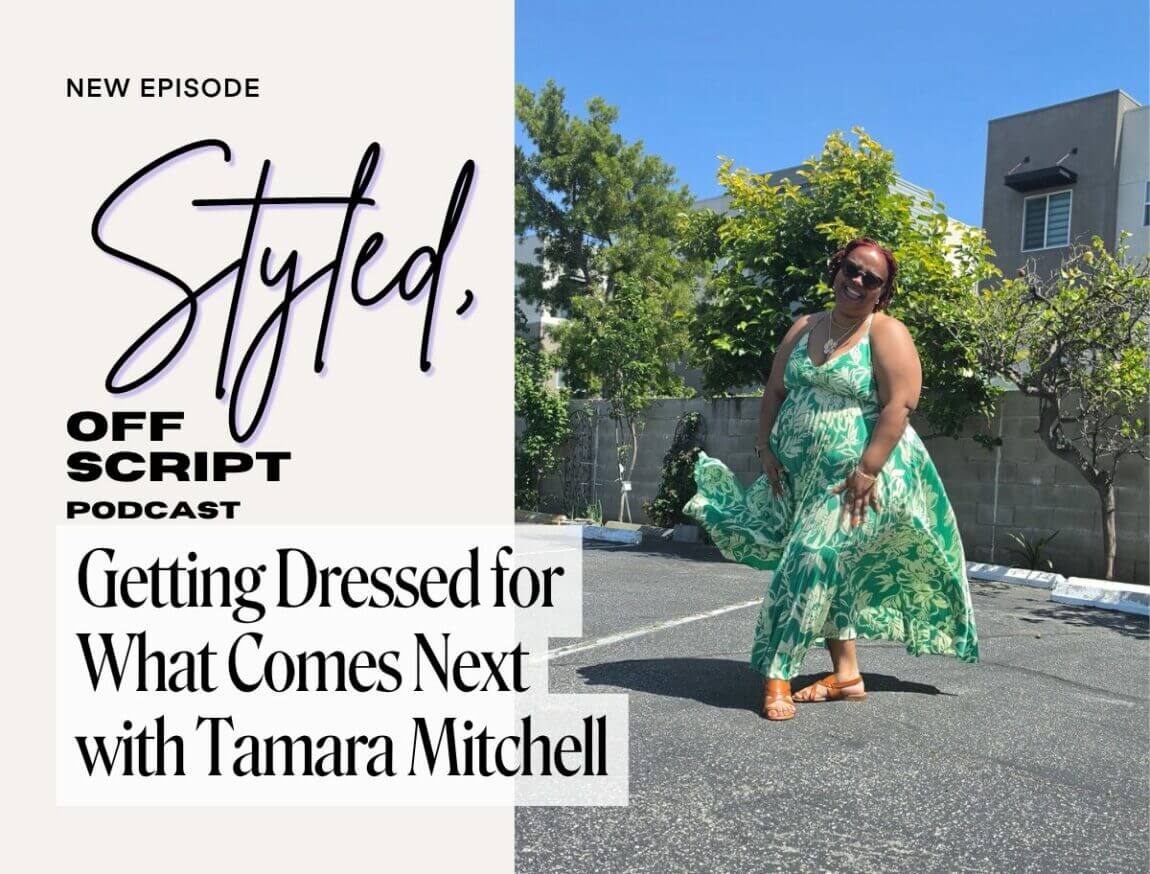
In Episode 8 of Styled, Off Script, Tamara joins Marge, Liz, and Maloree to talk about living in the unresolved middle: exploring a career in styling, creating fashion content, raising two teenagers, and discovering what comes next without pretending she has already arrived.
“Right now, getting dressed gives me hope because it’s the one thing I can control in my day.”
Listen to Episode 8 of Styled, Off Script to hear Tamara’s full conversation with Marge, Liz, and Maloree about career transitions, creative identity, breaking fashion rules, and the surprisingly powerful role getting dressed can play when life feels beyond your control.
Personal Style When Your Everyday Life Changes
Before her layoff, Tamara’s clothing had a built-in audience. She worked in a creative environment and deliberately chose pieces that attracted attention, sparked conversation, and pushed against narrow ideas of what a manager—or a plus-size woman—was expected to wear.
When that daily routine disappeared, her love of expressive clothing did not disappear with it. What changed was the context.
Without a workplace to dress for each morning, Tamara had to decide whether style still mattered when no one was expecting her to show up. Her answer became a recurring content series called “Fit Friday,” where she throws fits to keep from throwing tantrums.
The series gave her a reason to return to her closet, experiment with statement pieces, and create something during a period when so much felt outside her control. Getting dressed did not solve the uncertainty of unemployment, but it gave her a tangible way to participate in her own life.
You Are More Than the Role You Used to Play
Career changes often force us to confront how much of our identity has become attached to a title, schedule, or professional environment.
Even when a job was no longer fulfilling, it may have provided structure. It told us when to wake up, where to go, how to spend our time, and sometimes how to present ourselves. When that structure is removed, the freedom that follows can feel less like immediate possibility and more like disorientation.
Tamara’s story resists the pressure to turn that disorientation into a tidy reinvention narrative. She is not looking back from the finish line. She is exploring styling, building her online presence, and learning what she genuinely enjoys while still dealing honestly with the financial and emotional reality of a layoff.
That unfinishedness is precisely what makes the conversation meaningful. Self-discovery does not always happen after the difficult part is over. Sometimes it happens while you are still living through it.
Authenticity Is Not the Reward at the End
While discussing the challenge of creating content, Tamara offers one of the episode’s clearest insights:
“Your truest authentic self is what people come back for.”
It is tempting to treat authenticity as something we can access once we feel more confident, more successful, or more certain. Tamara’s experience suggests the opposite. Authenticity is not the polished result of having everything figured out. It is what allows other people—and perhaps more importantly, you—to recognize who is still there during a period of change.
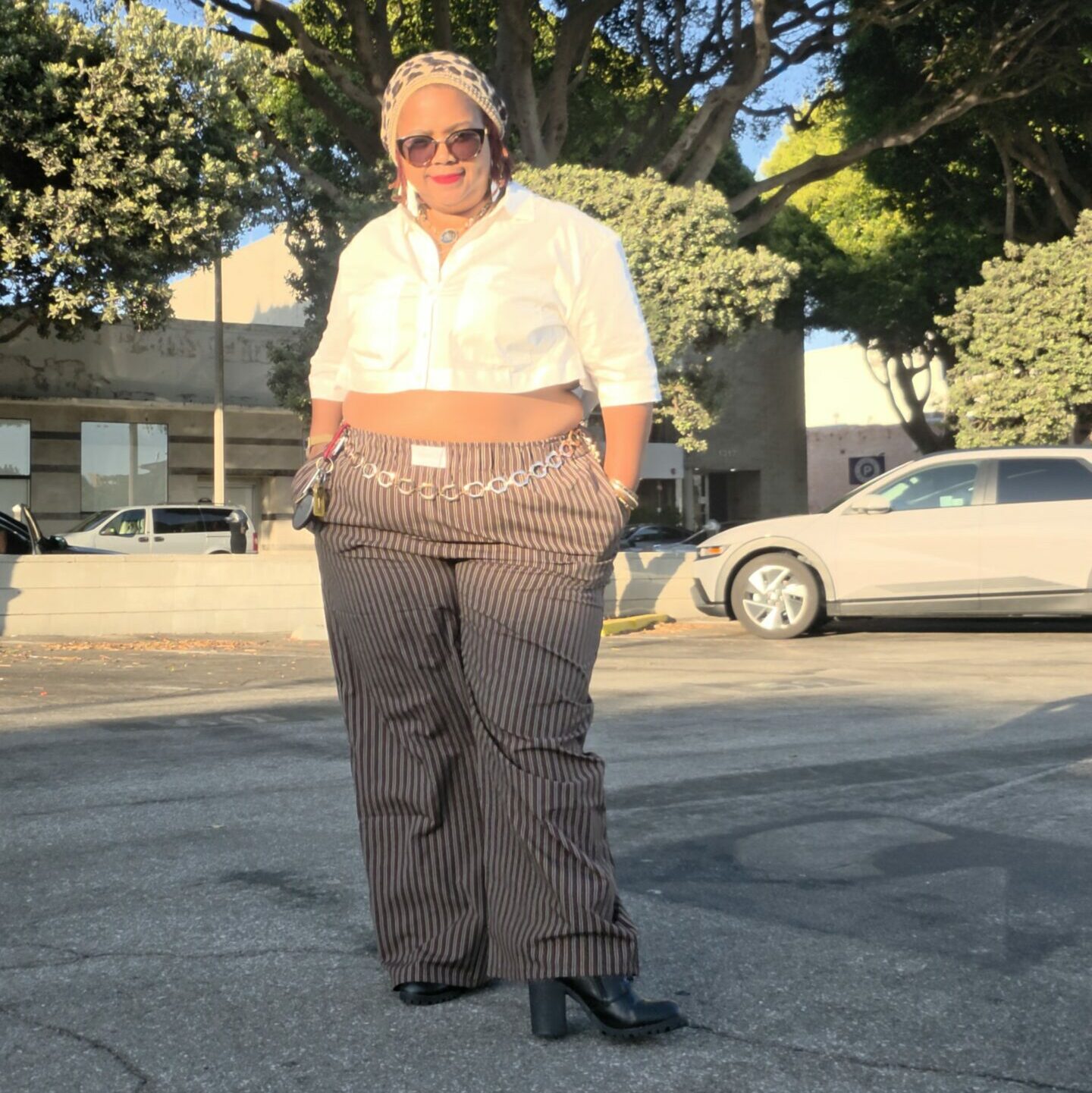
For Tamara, that means continuing to wear crop tops, dramatic prints, flowing dresses, wide-leg pants, and the pieces that feel expressive enough to be seen. She is not dressing to prove that the setback did not affect her. She is dressing as an honest reminder that uncertainty has not erased her.
Advice for Navigating the In-Between
Rather than presenting a traditional SOS in this episode, we asked Tamara what she would tell someone standing where she had been nine or ten months earlier.
Her first piece of advice was practical: invest more time in the work you genuinely care about before you are forced to depend on it. Tamara had wanted to explore styling for years, but work gave her an understandable reason to keep postponing it. After the layoff, she found herself facing both the freedom and the pressure to finally begin.
That does not mean every interest needs to become an immediate source of income. It means paying attention to the ideas that continue to return—and giving yourself a chance to build confidence, skills, and momentum before you have a finished plan.
Tamara also spoke about trying not to take the layoff personally. That remains complicated, particularly when an organization you gave years of your life to appears to move forward without you. But she has begun separating the end of the job from her own value.
As Tamara put it, what is meant for her is for her. The role was not meant to remain hers forever, even if she might not have chosen to leave on her own.
Her advice is not to rush through the grief or pretend the financial reality is easy. It is to begin making room for what you care about while acknowledging that an ending can be painful and still create movement.
“What did I care for? And how could I lean more into that?”
Statement Pieces as a Place to Play
One of the things Tamara is making more room for is play.
Her closet is filled with statement pieces, and she describes putting them together as a creative puzzle. Everything she buys brings her joy; the fun comes from discovering how a dramatic print, flowing silhouette, crop top, or bold color can become part of an outfit that feels entirely her own.
That approach inspired The Made You Look Box.
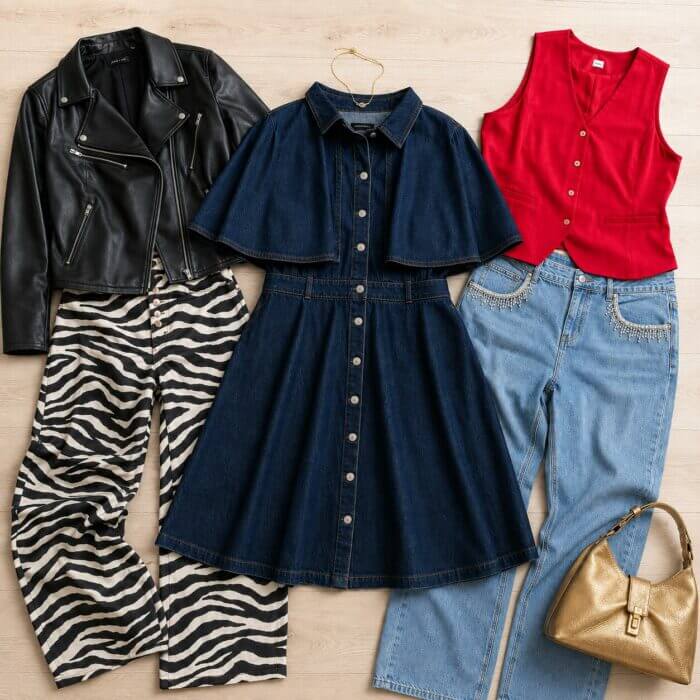
Straight from the latest Styled, Off Script, the box is built around pieces that make people look twice: bold color, expressive prints, conversation-starting silhouettes, and easy basics that help everything feel wearable.
The five pieces are not meant to create one perfectly matched outfit. Think of them as new possibilities for your closet—a statement maker to build around, a familiar basic that gives it somewhere to land, or the piece that makes an everyday outfit feel a little more like you.
Because sometimes the most exciting clothes are not the ones that quietly disappear into your wardrobe. They are the ones that give you something to play with.
Tamara’s story reminds us that moving forward does not always begin with a complete reinvention. Sometimes it begins by returning to what brings you joy—and allowing yourself to take it seriously.
Got a style dilemma?
We’re taking real SOS submissions for future episodes.
Whether you’re:
- packing for a trip
- stuck in a style rut
- navigating a wardrobe change
- or just not sure what to wear
Submit your own SOS request and we may feature it on the show!
Follow Tamara Mitchell
Tamara is a fashion and style creator building a styling practice rooted in expressive, authentic personal style. Follow her evolving journey, outfit inspiration, and “Fit Friday” series online:
Website: iamtamaramitchell.com
Instagram: @iamtamaramitchell
TikTok: @iamtamaramitchell
Styled, Off Script, is a podcast about personal style, fashion, and the real relationship we have with our clothes—and how it evolves alongside who we are.
Powered by Dia & Co, each episode features candid conversations exploring style, identity, self-expression, and the real-life moments that shape how we get dressed.
Also available on Spotify, Apple Podcasts, iHeart, Amazon, or to read the full transcript, keep scrolling.
Listen to the Conversation—or Read the Full Transcript
Hear Tamara’s full conversation with Marge, Liz and Maloree on Styled, Off Script, or keep reading for the complete Episode 8 transcript.
Click for Full Episode 8 Transcript.
Marge Okay, welcome back to another episode of Styled, Off Script. I’m Marge, one of your co-hosts, joined by Liz and Maloree. And we have a guest on this week’s episode. We’re joined by Tamara.
Liz Hello!
Maloree Hello!
Liz Whooop!
Tamara Hey!
Marge This is awesome. This is awesome. When we first—or when I first sort of pitched this idea to Liz about starting a podcast, I was like, we’ll have guests. We’ll definitely have guests. And then we started it, and we’re like, will we have—like, how do we—what happens? Okay, now we actually have to, like, figure out who we’re gonna have as guests. And very funny enough, right after—I think it was even the very first episode.
Marge So from day one, Tamara’s a day-one Styled, Off Script listener. Tamara reached out to me on LinkedIn and said, “I listened to your podcast. I would love to get to know you. I love style, personal styling, and any chance you want to meet and connect, and—and we’ll take it from there.” And we met shortly thereafter. And I think quickly we said, “Well, this should just be an episode of the podcast.” And that’s—that’s where we are today. So, Tamara, we’re so excited to have you. Thanks for coming.
Tamara Thank you for having me. I’m so excited.
Marge Woo-hoo. So why don’t you tell us a little bit about you? What—what maybe brought you to Styled, Off Script? Like, what popped up on your feed that you were like, “Hey, wait a minute, that sounds interesting”? Or I believe you were a Dia customer before, or had, like, followed us on social, maybe.
Tamara Yeah, I have definitely been a Dia customer for a really long time, especially when I first started my full-time work career. And so I’ve definitely been a Dia & Co. customer. But then also, what interests me about the podcast was that this—this idea of this SOS, and, like, how much fashion and style actually plays into my personal day-to-day, and just kind of, like, having conversations around it. And so I was just really excited to—to see how I could lean into that a little bit more.
Marge Mm-hmm.
Marge Yeah, absolutely. I would love to hear—so I think a great way to start this off is, I think we would all love to hear how you describe your own personal style, and has that evolved over time? And if so, what are some—maybe some highlights of that—of that journey?
Tamara Yeah, so I have been now unemployed for about nine or ten months, and I—I was very adamant on having a type of style that called for attention. So I was intentionally wearing things that were conversation starters. And—and so when I got laid off, there’s no place for me to go, in a way. And so trying to figure out how to continue to be that outspoken person with—with my style, but also, like, making it make sense. But—but yeah, because I am also—I’m a single mom of two—of teenagers. And so weaving in all of these different things that are me in my personal style. I feel like I lost the question along the way, but—
Marge No, you—you got it. You got it.
Tamara But—but what was the original question? I feel like I thought—
Marge Like how—how your style—you—you spoke to it at the beginning, like the conversational pieces. And actually, that made me think that there is, like, a pattern definition called conversational prints, or, like, fun ditsy patterns—patterns that have, like, more of a recognizable shape, or, like, dogs or cats or fish or, like, whatever—called conversational prints that are, like, specifically made to draw people’s attention in to start conversations about. So you talked about wearing those conversational pieces, and then when you got laid off, not really having a place to be able to wear those things or have that style expressed in the same way.
Tamara Yeah, definitely. Because I—I loved wearing things that were, like, flowy and structured at the same time, and things that—things that were smart casual, right? ‘Cause, like, I—I didn’t want to wear business casual. You can’t put me in a uniform. To give me a dress code is wild, because I’m not going to listen. I couldn’t do a job where it required me to wear a uniform. I have done jobs that required me to wear a uniform, but at 40, try again. But—but the job, I at least was able to wear whatever I wanted to, and I definitely pushed those boundaries as often as I could.
Liz Hard.
Marge Yeah. Yeah.
Tamara It was actually funny. My boss, in a performance evaluation, had said—it was, like, something along the lines of, “I need you to dress more professional because—because you’re a manager.” And when she said it, I was like, “Hmm, interesting,” because I don’t think I’m wearing anything that’s not professional. But I was also pushing the envelope a lot.
Marge Right.
Tamara Like, I am the type of big girl who loves showing off my legs. I love showing off my arms. There’s no part of my body that I have any issues showing. I love a crop top, so I’m gonna show my belly. And so those were things that—I was working at a non—a small nonprofit where there’s a staff of six, and it’s an art institution, so there was—
Marge Yeah, you would think creative.
Tamara Yeah, and there—there was no real rules around what you could wear. So I pushed that envelope as much as I possibly could, and I enjoyed it a lot.
Marge Love that. Well, fashion is, like, truly an act of art and expression. You would think—my logical mind goes, well, in an art environment, wouldn’t you want your leaders to reflect creativity and, like, express that level of understanding and an ability to be creative in all the ways of—of art expression? But, you know.
Liz Tamara, you’re making me think about—I don’t know if this is true to your story, but, like, I had to wear a uniform in junior high. And I feel like I’m still rebelling against that in, like, getting dressed every day. Just the idea that I had to—like, I was forced to—to wear something. This was so long ago, but I was forced to wear something that, like, I didn’t want to be wearing, where I had very little room for self-expression. And now, 35 years later, I’m still, like, trying to remove that uniform from my psyche and, like, live in the “I can wear whatever I want. Don’t stop—don’t try to stop me,” like, attitude. And right now that’s, like, a very casual expression, but I think it can come out in, like, lots of different sort of fun, spicy, creative ways.
Tamara For sure. Yeah. I mean, it’s helpful when you’re a kid to wear uniforms because you got bullying and you got, like—there’s—there’s things that come along with it, and it’s also very helpful on the parents. But as an adult, no, I don’t want to. I want to wear what I want to wear, and I want to have fun with it, because style should be fun. Getting dressed should be fun. It’s like playing dress-up every single day, and that is beautiful.
Marge Money.
Marge Especially, too, I think, as—as folks who haven’t had all the options that everybody else has had in terms of—of clothing, as—as someone who’s plus, like, there were so many years in my child—like, late childhood, teenhood, early adulthood, when the idea of—of playing dress-up or having clothes—even uniforms didn’t fit. My mom actually just reminded me of this—this, like, volunteer day that we did at a golf course near—near us. And, like, neither of us golfed, but we, like, went for the vibes or whatever. And the uniforms that they gave us were, like, we had to wear khaki pants, and then they gave us a polo shirt. Well, the polo shirt that they gave both my mom and I was maybe a size large. Did not fit either of us. Was, like, skin-tight, sausage—like, it was awful. And we felt so uncomfortable the whole time that, like, it just—in that moment, it was like, “My God, like, every part of this is wrong. If I could have just worn the shirt that I have in my bag, I promise I’ll do a better job.”
Maloree Mm-hmm.
Marge But that, like, constraint, when you don’t have all of the options, when you have to wear what somebody else is telling you to wear, it’s like it just sort of weighs on you, that then when you finally have more options to play with, you’re like, “Okay, this is fun. This is enjoyable. I don’t ever want to go back to that world. I’m gonna create my own fun—fun style.” And—and, Tamara, one follow-up: Were you always this stylish? Was this always sort of the—the go-to for you? Was style something that you loved to play with, or was that something that was learned over—over time?
Tamara Definitely learned over time. In high school, I went through, like, my punk phase. And so I literally was wearing black every day. Only wore jeans. Only wore, like, a big black, like, oversized sweatshirt or jacket. The idea of wearing a dress or a skirt or shorts—forbid—was not even on—
Marge Hell yeah.
Liz Mm-hmm.
Marge Ha ha.
Tamara —anything I ever thought of. And so—so now, when you look at my wardrobe, I limit—I will not put black in my wardrobe. I will intentionally avoid black at all costs. There is black in my closet. I’m not gonna—black still has its place. But—but it’s very—my wardrobe is now very colorful. I prefer to wear dresses. I prefer to wear skirts. I prefer to wear shorts. And so there’s definitely been—a huge change. And I think growing up on, like, Project Runway, even though they have not—the whole entire time—have not been kind to plus-size people. The amount of times they did, like, a real-world episode and the contestants would be so mad that they had to dress a real-size person. But I loved—I loved watching Project Runway and fashion shows, but I never thought of my own personal style or fashion being something that was even in the realm of what I could do. But I’ve always been interested in it, because I’m also a very problem-focused person. So, like, when I see a problem, I want to create the solution. And so whenever I went shopping for clothes in-store, which, you know, now is very complicated as a plus-size person, when I would go shopping in a store and I would see that things aren’t fitting or things were just not cute or whatever, like, me wanting to say, “Okay, well, I can design clothes.” I have not gotten that far. I decided instead, let me style people first, figure out what people need and, like, you know, where the gaps are, and then actually design clothes. And so that’s kind of where I’m at now. But in regards to developing my own style—
Marge Yeah.
Tamara Following people who look like me, seeing how they style themselves, playing with—just playing with clothes and just, like, playing dress-up as often as I could, and just trying to always push the envelope and just play. Like, it’s a—it’s a fun puzzle to me to go in my closet and, like, pull pieces, because a lot of my closet are statement pieces. And so trying to figure out how to style statement pieces—is a—is a fun puzzle in itself. So everything I’ve purchased brings me joy. And so then trying to figure out how to play with them in a way that makes sense to me is just basically how I’ve developed my own personal style. But just—just having fun with just pushing the envelope. Like, I—I—I think literally that’s the way. Like, I like to consider myself a rebel in that sense, because, like, I won’t wear black because it’s—it’s, you know, air quote, “slimming,” and I won’t wear—like, there’s—there’s rules I intentionally try to break all the time. Like, I’m going to wear horizontal stripes and I’m going to, you know, like, all the different rules, and I’m going to try to break them every time, because that’s just—I’m a rebel. I’m a rebel in that way.
Marge I love that. We—we had a great episode about the—about breaking rules. And I think finding ways, even if it’s just, like, a rule that you know that you’re breaking, it’s kind of like the—we spoke about the power of a leather jacket. It’s sort of that, like, little, like, nod to being your own kind of badass that, like, it’s for yourself. Like, it helps sort of fuel—like, fuel your own sort of who you are and say, like, “No. Like, I’m gonna do it. I’m gonna wear—I’m gonna wear what I wanna wear.” I have a side—a side-quest question. You mentioned having two teenagers. Does—do your children have an affinity for style or fashion? Or do they have an input, or, like, do they play with style and fashion with you or without, or do they care at all?
Tamara Mm-hmm.
Marge I’m always curious to hear what Liz and Maloree’s kids are up to in—in terms of style and—and how involved they are.
Tamara Yeah. So my son is very special. He—he is indeed on the spectrum, so he is very particular about what he wears. And he is—he is at this phase where he only wants to wear sweatpants and T-shirts. But—and he’s very particular about the fit of them and the fabric and, like, how they feel on him. And so he’s very particular about that. So I cannot shop for him. He has to come with me—
Marge Fair.
Tamara —because he’s very particular.
Marge Yep. Fabric is huge. Fabric is such a huge, huge deal. And shopping online when you have sense—like, when you have that to a—like, another level, it’s so, so difficult. You wanna touch and feel things, and, yeah, it—that’s so important. Fabrication makes a huge difference.
Tamara Yeah. So that’s my son. But my daughter—my daughter is—is a mini-me. And so she is definitely trying to push the envelope with her own personal style. And so she—she likes to do, like, leg—like, furry leg warmers, and she loves to wear, like, all black, but she loves baggy and oversized. And ’cause she’s—she’s a size zero.
Marge Ha ha ha.
Liz Mm. Cute.
Tamara She’s zero—she’s size zero and she’s tall. And so—so she gets to play around a little bit more than I could have done when I was her age. So she’ll, like—she likes to play with black, and she loves to play with just, like, very baggy jeans. And, like, so she—she’s very particular, and she loves anime. And so she does, like, a lot of cosplay and stuff like that. And so she just—
Marge Yeah, yeah.
Tamara —and she weaves that into her style, and, like, yeah. So my daughter is a little bit more me, but she makes it her own. She doesn’t try to copy me, because I can’t put my daughter in a dress. She’s very, in a way, she’s kind of andro in that way. Like, she doesn’t—she does—like, she doesn’t want to do the feminine, girly things that I would like for her to wear, or for me—like, that I personally do.
Marge Yeah.
Tamara But she does definitely have her own personal style, and it’s really fun watching her play with clothes and, like, how she has fun with it. And I recently taught her—like, got her into thrifting. And so—so that’s just really fun, ’cause my son was like, “Thrifting? Like, buying clothes that other people have already worn?” He was—he paused. But my daughter was super excited about it.
Tamara And that’s how she got her first pair of Doc Martens, which she loves—loves so much. And so—so, yeah. So my daughter has definitely taken nods from me and, like, continues to develop her own personal style and separate from me, because, again, I cannot get her to wear a dress. So it’s—it’s just kind of fun.
Liz Love that.
Liz I think—I think it’s so interesting. I also have two teenagers, and I think it is so interesting watching them walk through their own style journey. I mean, obviously we could do a whole other podcast—Marge, add it to the list—about this. But my two kids—my older child, in particular—is on a sort of figuring-themselves-out gender journey, and a huge part of that has to do with style. And they also have recently discovered thrifting, thanks to me. And thank goodness for thrifting, because, like, helping a teenager find out—figure out their style is quite expensive. And so thrifting plays a really big role in helping—making this all manageable. But, like, trying to figure out that role of parent, of, like, where to step in and sort of assert yourself and, like, give guidance, and also, like, where to just be supportive and allow them to take risks and figure out their own identity. It’s—it’s a really interesting place for someone like me to be in, who, like, has such a strong opinion or point of view in terms of, like, what might work well and what maybe doesn’t work as well, and—and sort of has been on a style journey of their own evolution, too, and sort of figured out what works well for them. So, I don’t know. I just think being a parent to a teenager is all kinds of crazy, and fashion and style is a part of that.
Marge Absolutely. Absolutely. I know, as—as soon as sort of I heard Tamara talk about that, I was like, “Ooh, y’all can—can bond over—over where—where to shop.” And then, Mal, you can take notes for a couple of years ahead.
Liz Mm-hmm.
Maloree Yeah.
Liz The future, yeah.
Marge Awesome. So I want to sort of take us back a little bit to maybe the origin of—or something we talked about in the first conversation that we had, Tamara, was how this sort of life moment of being laid off and—and this, like, moment of reset, I’ll call it, that then maybe became a catalyst for leaning further into your own style and even that maybe propelling this next chapter of your life. Curious if—you’re welcome to share or say you don’t—like, curious maybe how that impacted your day-to-day style, how that sort of impacts your day-to-day style now, and what has getting dressed felt like throughout that process?
Tamara Yeah. So I hated my job. I hated it with a passion. And—but what I had enjoyed about my job was they took a chance on me to—because I always had an interest for—for marketing, but I hadn’t actually had a care—like, a job in marketing. And so they gave me an opportunity to take on a marketing role, and that was—that was fun. And what—me and backstories. Every single time I try to give a backstory, I forget the question.
Maloree I love the backstory.
Liz Keep going. Just talk. You’re great.
Marge Yeah.
Tamara Okay. And so when it came to getting laid off, in regards to getting dressed, I’m still—I still want to push the envelope. And so I created a series that I call Fit Friday, where I throw fits to keep from throwing tantrums. And so, yeah. And so I’m on episode 21, so—
Liz Oh, my God.
Tamara Tomorrow’s episode—
Marge Quite a bit ahead of us. Yeah. Nailing it.
Tamara Yeah. Yeah. I—so I will have my 22nd outfit coming soon. But literally, I did it out of this realizing, because Liz said earlier, we were surviving instead of thriving. Like, literally, I was losing my mind every single day navigating unemployment, because I’m—I’m, again, I’m a single mom—
Liz Yeah.
Tamara —navigating unemployment. And so trying to figure out where money’s coming from is a daily stress. And so—so I—and—and then also in this season of trying to figure out, who am I going to be now that I do not have this job that I’m going to every day? Like, even trying to figure out what my day-to-day will look like, ’cause, you know, I was waking up at 4:30 a.m. every day.
Liz Mm.
Tamara Then getting the kids to school at whatever time I had to get them to school, being at work for whatever time, coming home, maybe cooking dinner if I felt like it, and then repeating, right? And, like, back in bed, like, 8:30, and, like, repeating. And that’s just what my day looked like every day. And that was just—I was on autopilot every day. And so then when you remove that job, and now—
Liz Mm-hmm.
Tamara —you have all the time in the world to do the things that you actually want to do. ‘Cause I had decided I wanted to—to be a stylist, I think, two—two-plus years ago. I had first started saying, “I want to be a stylist,” but I hadn’t actually done it. And my excuse was I was busy with work and that I didn’t have the time to do it. And so when you lose your job, you now have all the time in the world, or at least that’s the idea. And so—
Marge Yeah. That’s what they think happened.
Tamara Yeah. And so when I—so—so then it’s like, okay, well, now you gotta put up or shut up, because you have all the time in the world now to be the stylist that you claimed you wanted to be. And—and so now I’m navigating this season where it’s like, okay, so I’m going to create my business as a stylist. What does that look like? What are you—what does your day-to-day look like? And so—so now the idea of waking up at 4:30 in the morning is wild. I cannot wake up at 4:30 in the morning anymore. And—but—
Marge Nor should you. No way.
Tamara I did enjoy—like, I’m not even gonna make it seem like I hated waking up at 4:30 in the morning. I loved it back when I did have the structure of the day, because the world is asleep at 4:30 in the morning. Like, there was just some peaceful and calmness to 4:30 in the morning. But there’s no reason for that now. Like, I don’t need that calmness, because I have the calmness all day if I allow it to happen. ‘Cause, you know, again, I have two teenagers who are home for the summer. But ideally, they—
Liz Mm-hmm.
Tamara —function on their own, and they don’t need me as much as they did when they were five. And so—and—and they can cook their own meals, and they can, you know, they can bathe themselves. You know, questionable. You know, was it? Because I definitely smell something.
Marge Right.
Liz Yeah.
Liz Yep. Yep. Tamara, I can’t believe, like, how much what you’re saying is resonating with me. Like, I, as a member of the former 4:30 club, you’re, like, just really—what you’re saying is really landing. Like, I also went through a layoff. And I guess maybe the difference was I was obsessed with my job when I went through my layoff. And it was not only something that, like, I enjoyed doing and, like, found really a lot of fulfillment in, but it also was the first time that the role that I was laid off from was the first time that I, like, had a true sense of, this is, like, what I feel like I’m meant to be doing. And I was leading a—a large team. And when that, like, sort of disappears overnight, you just—you lose such a sense of who you are. And for me, and it sounds like for you too, there’s, like, a clothing-style component connected to that. Like, I also—I didn’t know, because I was no longer dressing to be, like, on screen all day long or to be in front of my team, I no longer knew, like, what I was supposed to be putting on my body in the morning. And that sounds so ridiculous. Like, of course I was still getting dressed even when I wasn’t, you know, in front of my team before the layoff, but all of a sudden it just sort of felt like, what’s the point? Who am I doing this for? I don’t know who I am right now. And not having that regularity and that structure, like, really threw me off. And it was just an unexpected layer, I guess, to navigating the layoff that I found myself, you know, really sort of stuck in and unsure what to do with for a long time.
Tamara Yeah. Yeah. I mean, I’m sitting here nine—nine or ten months since my layoff. And so it’s just now starting to, like, truly hit me that, like, you don’t work for anybody. Like, it’s like—it’s just—it’s just now starting to really set in. And I even see myself going back sometimes to, like, look at what my job—like, what—what they’re doing now, because it’s—’cause still, it’s ’cause they laid me off only.
Liz Mm-hmm.
Tamara Right? Like, it—it’s—it’s not like a whole entire team was laid off. They only laid me off. And so trying—like, looking back at, like, what are y’all doing now that you don’t have me? Like, do you even care that you don’t have me? And so, like, navigating that and, like—but it’s just now starting to hit me that, like, you don’t work for that place. And it’s also funny because I ran into somebody who knew me when I worked there, and they didn’t even know that I was laid off.
Liz Mm-hmm.
Tamara They didn’t even know that I was not there anymore. They were like, “We just thought that you were somewhere else.” And I’m like, wow. Like—like, it—like, in regards to identity, like, that they don’t care that I wasn’t there anymore. Like, it’s like—and navigating that. Like, it’s—it’s very hard to realize that, like, in a sense, you meant nothing to this organization who you dedicated—
Liz Mm-hmm.
Tamara —so much time to. And, like, I was—’cause I was there for, like, three and a half years. And so that’s a lot of time to dedicate to a place that didn’t truly care about you and was willing to let you go. And, like, yeah.
Liz It’s a lot of 4:30 mornings. A lot of 4:30 mornings.
Tamara Yeah. Yeah. Wow.
Marge So I think that brings us to sort of what’s—what’s next and what—and what you’re excited about sort of in this next chapter. Are there things that you found in this newfound “you’re your own boss” and—and sort of the—the captain of your—of your ship, like, that you are loving in regards to your style or even just, like, as a part of your life? Obviously, not waking up at 4:30 is, I would think, would be a huge one, but are there other things that you found surprising and fun and enjo—excuse me—enjoyable that you didn’t know was there before? Are there passions and—and things—you’ve—you’ve mentioned spending more time with style and creating content and things. Like, what have you found that’s fun and enjoyable to you?
Tamara Yeah, definitely the styling stuff. So I—I get to play in my wardrobe a lot. Also, as I am developing my business as a stylist, like, finding opportunities to style more people. So, like, for instance, coming up, I—there’s—it’s called Thick Thrift, and it’s an L.A.-based plus-size market. So, like, they have, like—
Marge Well—
Tamara They have 50-plus vendors every month. They just recently introduced it to the O.C., and then they’re supposed to be having a New York one coming up soon. So, yeah. And so—but I got approved to be a vendor.
Marge Mm-hmm.
Marge Ooh, that’s awesome.
Tamara And so, yeah. And so my plan is to be a stylist at—at this event and do fit checks for people. So allow them to come to me with a—a piece, and then I’ll, like, offer them style advice in person. And so—so that’s what—so that’s one thing that I did. And then kind of, like, how I reached out to Marge for—to just do a coffee chat, I offer those out all the time. Like, “Hey, let’s just talk.” And so that’s—so that’s one of those things that—
Marge Yeah.
Tamara I—I just enjoy talking. There’s just something fun about just, like, relating to people and just having conversations about whatever. Because it is—it does get very lonely at home when you—it’s just me and my kids, and I can’t have fun conversations with my kids, you know? I’m already trying to figure out y’all lingo to try to—
Marge Sure.
Liz Totally.
Liz Yeah.
Marge Throw a couple six-sevens in there and, you know, maybe that’s passed.
Tamara No. No. It’s—it’s actually not. It’s not passed. It’s still going on.
Liz Marge, that’s so passé.
Maloree No, my five-year-old says six, seven. Yeah.
Tamara It’s still—but that, and then also just, like, even going to—just go to a café and just, like, or the beach and just, like, exist is—is just really fun. Because I—I come from a—my mom was a single mom also, and she worked at the post office for 20-plus years before she passed. And so the idea is you work a nine-to-five, you move up, and that’s what you do, right? Like, you—you stay in a job for 20-plus years, you retire from that job. That was always the idea. And so now that I’m navigating this season, because I’m, you know, I’m 40, I—and—and there’s definitely an idea that I had of where—where I should be at 40. There’s an idea of how much money I should be making at 40. There’s just all of this—preconceived idea on what I should be at 40. And now saying, well, that’s not what I want to be. I want to be this, and having fun exploring what that is. And so just even trying to explore moments of doing nothing is—is—is very, like, new, because, like, in a sense, I always had to be busy. And—and—and now I’m not busy, and I’m trying to navigate that—
Marge Yeah.
Tamara —feeling of not being busy, but, like, also enjoying not being busy. Like, that’s—and so—so, yeah. So those are—those are some things that definitely I’ve enjoyed, having fun. And then also re—having fun with shopping again. So I thrift a lot, and it’s just really fun to shop in that way. In all honesty, I haven’t been to any, like, regular stores. I don’t even know what it looks like to shop in person at this point, which is interesting because I’m trying to be a stylist.
Marge It’s not great. It’s not great, Tamara. It’s not great.
Maloree Mm-mm.
Tamara But—but definitely wanting to, like—I don’t know. I’m just having fun with playing and—and—and, like, seeing what that is. Even how I cook food. Like, I—I love to eat, but I also love to cook. And so having fun cooking things that are exciting to me, which also, I think—I think—which is—
Marge Yeah.
Tamara Like, food and clothing style go hand in hand for me. Like, there’s just something about con—consistently trying new things and, like, seeing what you love, what you don’t love. And, like, they just go hand in hand. So just doing more and more creative things, because I want to live a creative life, and trying to figure out what that looks like in this season. Yeah, that’s—I think I answered the question.
Marge Yeah, that was—you covered so many things that I—I think are—are fantastic bits of advice for—for everybody. In fact, you said something that my therapist repeats to me often. I was someone who, pre-COVID, worked in an office every day with a majority of my friends and then was busy almost every weekend or night or worked late nights, and so was constantly busy. And then COVID hit, and I lived alone, and busy didn’t exist. And so I had a very, very hard—I, like, leaned hard into that because of mental health, and I sort of crashed and burned in it because I realized I was just so burnt out from everything. But then getting back out into the world was very, very, very difficult for me because I had developed—I had worked really hard during that time to understand who I—who I was, like, without the working in the office and the New York City and all of the everything going on, that it was like, okay, this is who I am. What do I like to do? What do I want to do? Who do I want to hang out with? What do I like? What’s—what’s enjoyable? And her biggest advice was, like, just go somewhere. Anywhere. You don’t have to talk to anybody. You literally can leave. You can get to the door and you can leave. And at least you went somewhere. You can take three steps outside of your house and turn around and come back, but at least you took those three steps. And I think for a long time, and as I sort of reflect even further back onto my life, I was almost always someone that was doing something with a friend, and the something was what that friend wanted to do.
Tamara Mm.
Marge And I didn’t really learn to figure out what—and then I sort of got busy with work, and then you’re doing the work thing that work wants you to do. And so I didn’t really figure out, like, what I liked to do. Like, I knew there were parts and pieces, but she was like, just go sign up for a class or sign up for a music thing or go see a show or go to a concert or take yourself out for dinner or go to the library. Like, start a hit list of things that you wanted to do that you thought that you either needed a partner or a friend, or that you would say yes to if a friend asked you, and just do it yourself. Or go to a coffee shop. Honestly, like, getting a dog was a huge part of that as well. It’s like having a dog that I can bring places with me helps take a ton of the mental pressure off of me. And then I’m just worried about, like, well, is she having fun? She’ll have fun anywhere. She’s fun wherever we take her. But, like, getting out of the house and just, like, being around other people, then the moment somebody says something, you’re like, wait a minute. You’re cool. Okay. And you never know how you—how that one interaction can play out in a million different ways. And you never know who you’re gonna meet, what conversations you’re gonna start, what things you end up—
Tamara Mm-hmm.
Marge —finding in common, what you learn from someone else that you don’t have in common. And it has introduced me to a huge world of wonderful people and wonderful new things that I never really made the time for before, which has also impacted my style and who I am as a person in my life in wonderful ways. And I think it’s, like, all of the—the jobs in my career have all been attributed to moments in my life where I really just got chatty and yappy with someone at the right place at the right time, never from actually interviewing or having a successful interview. I think I do okay, but have never gotten a job directly from an interview in that way. It’s just, like, I get in my head and whatever. And it’s all been, “Hey, I met you at this thing. Wondered if you wanted to grab coffee.” Like, we chatted it up, you get to know somebody. So you never know who you’re gonna meet, when you’re gonna meet them. And hearing you give feed—like, saying, “I reached out to people to have coffees,” or, “I’m going to places, I’m going to the beach, and I’m finding fun here, and I’m going here,” like, that is exactly—like, you’re making the most creativity and—and joy out of your life for you. And people gravitate towards people like that. And it’s about you. And they’re like, okay, I get it. And it’s—it’s, like, just awesome to hear other people like that. And—and I think having you speak so clearly about this chapter in your life is—is something that is kind of terrifying for everybody. And we know a lot of people that have—have gone through layoffs, and it’s often sort of met in such a—such an awful—and I don’t want to negate that at all—but knowing you’re not alone in it, and that there’s—there’s other folks that have—have gone through that experience as well. And—and you’re paving your own path. And that there’s not the right path for everybody. And the path you had as a kid can be different than the path you choose now. And—and just listening to yourself is—is really powerful to hear. So mad kudos to you, to listening to yourself and following that, because I think a lot of people would talk themselves out and find something else and take a different route. And it’s, like, very—brave and courageous to be like, “No, I got this. I trust myself,” or at least, “I trust a little bit of myself that I’m gonna try today, and I’m gonna just sort of—to—to throw fits instead of tantrums and—and try to go forward.” It’s really, really—it’s very inspiring, and it’s awesome. And we need more of that in the world than trying to conform to what people think we should have to have figured out. ‘Cause at the end of the day, none of—
Tamara Yeah.
Marge —at least what I’ve learned personally in the last year, none of that really matters. Nobody really cares what you do for a living at the very end of the day, in the darkest, deepest moments of your life. Nobody really cares that you had a nine-to-five and that, like—it’s just, like, yeah, we all gotta work. We all gotta pay our bills. But what—like, who are you as a person is so, so, so important. So mad kudos. And if you’re—I—I can just imagine the wave. I think about this with Liz and Maloree, like, the kids growing up in that aura, to use another young-kid term, is very exciting, to know that, like, the next wave of kids are—are seeing that example truly lived, not the pressure that maybe some of us felt to live the life that we thought we had to have.
Tamara Yeah, definitely. Definitely.
Marge So I would love to give you a space to talk about styling other people, if you want to, like, hype your—hype your—hype, or—or hype what—what you like about styling other people. Or maybe if folks wanna find you and get to know, like, more about you, or take you up for some style advice, if—if you’re interested in that. Like, feel free to hype yourself in.
Tamara Yes. Yeah, I—you can find me on anything—well, not anything—on TikTok or Instagram @iamtamaramitchell. And then I’m working on my website, but iamtamaramitchell.com. I did pay for an actual domain because I’m cool like that. So you can definitely find me. I have branded myself across all platforms that way.
Marge Hell yeah. Love that.
Tamara Because I am also a marketing person, so it makes sense. But you can find me on all of that. I’ll be at Thick Thrift. That will be August 15th in L.A. And so that’s the one place to—to find me. Also, I—yeah, I’m posting content all the time. I’m trying to get very consistent on it, but I am very human about it because—
Marge Hell yeah.
Marge Yep, that’s real.
Tamara Content creation is not for the faint at heart. Yeah, it’s just—it’s—
Marge What do you mean? You don’t just set up your phone and make a video? What?
Tamara I understand that there are people who can do that, but I am not one of them. It’s—I am trying my hardest to learn how to be more me on camera and not be so robotic and scripted. And so navigating that is really challenging, but also fun in a way, because one thing I’m learning is that—
Marge Nope.
Tamara —your truest, authentic self is what people come back for. So you can run yourself through AI if you want to and have AI design everything for you, but what people return for is you as your authentic self. And so trying to navigate that. But—but, yeah, I—
Marge That’s a quote. That’s a quote, Maloree. That’s a quote. That’s a quote. Yes. Yes.
Liz I love it.
Marge What I guess I would love to—to end this on: As we know, there are many in a very similar position as you. What advice would you give someone who was like you nine, ten months ago that maybe you—you wished folks gave you then? Or what was something that, like, you wanted—you wish someone had said right off the bat? Or maybe some advice you would give them now, sort of throughout the journey, on—on sort of taking the next steps forward.
Tamara Yeah. The—the funny part is, is I knew I was getting—I had—I had a runway before I was gonna get laid off. Like, I—I knew I was getting laid off, even though I did not know when, and they kind of, like, sprung it on me. But one thing—
Marge Funny how that happens.
Tamara Yeah. But one thing that I wish I would have done is to spend more time on the side hustle. Like, more time doing the thing that I actually enjoyed. So when the thing went under, I at least had the foundation of the thing that I actually wanted to do. And so that’s definitely, like, leaning into what I genuinely like to do. ‘Cause, like, I didn’t care for the job that let—that let me go. I didn’t care for it. And so what did I care for? And leaning more into that, or even utilizing the job that I had to advance the skills that I did want to learn, would have also been very helpful. And then the money part, definitely getting that little nest egg so that you don’t have to struggle. That—those are—those are probably the main things that I wish I would have done. And definitely—yeah, those are the main things. But also—
Marge Mm.
Tamara Like, not taking it personally. Because, like, yeah, I definitely feel some type of way about being let go, but what’s meant for me is for me. And that job was not meant for me. And I wouldn’t have let it go any other way. If—if they did not let me go, I would have probably still be—I would probably still be there today, even though I was quiet quitting a year before. So, but—but—but, yeah.
Marge And that’s—that’s really—that’s, like, so common. Like, ever—’cause I—we’re sort of told not to leave, that we have to stay places forever, and that we, you know, it pays the bills, so you gotta stick around. And, yeah. That’s—you’re—you’re starting a new—a new chapter in—in ways that are all your own. I guess the last few things are around—I wanna end on some fashion—maybe some fashion rapid-fire questions, if you don’t mind. Unless, like, Liz, Mal, is there anything that I’m—I’m listening—I’m—I’m missing on your end? Any questions? This has sort of taken a wonderful, very natural turn without me having to do a whole lot of questioning, but—
Tamara Definitely.
Liz Yeah, I love it.
Marge This is great.
Liz I think it’s good.
Maloree Yeah, it’s been very interesting. I personally have never been through a layoff. I’ve survived the layoffs, which has always been, like, the other side of it’s hard too, because it’s like, all my friends are gone. But, like, I can’t even imagine. And I think it is, like, Marge said earlier, you’re doing the thing. And it’s so cool.
Marge Yeah.
Maloree And it’s so—to me, I love seeing people who kind of maybe needed the push out and took it and ran with it, instead of just letting it, like, tear you down. And that, to me, is so inspirational and so admirable. And I—I’m amazed, honestly.
Tamara Thank you.
Marge Yeah. I—I feel like these are stories that we don’t hear very often, but we should, because I think they’re far more common than people, like, “I left a job I loved, and I started another job that I loved.” And it’s like, what the fr—what—what delusion do you live in? What delusion?
Maloree Mm-hmm. Yeah.
Liz Yeah, right.
Liz I just—I know we’ve talked about this on other episodes, so I’m sorry if I’m repeating myself, but I also just think that, like, every time you start something new or you, like—if you’re—if I’m—if I’m putting myself in a positive mind space, which, honestly, this conversation has really helped me to do, so thank you, Tamara. Like, every time you go through a transition of some kind, you do have the opportunity to, in some ways, like, not just reinvent yourself, but sort of redefine or reconfirm, like, who you are and how you want to present yourself to the world. And I think that that’s, like, an important moment to pause in too, and not just, like, let sort of creep by as you’re navigating all the other craziness that goes on through major life transitions. But, like, to see it as a moment where you’re like, you do have this chance to pause, and you do have this chance to say, like, were my—were the right priorities in place? Not just the big priorities, but, like, how I put myself out there in the world too. And I don’t know. I think that that can be something that’s very empowering that maybe can be missed, and that, Tamara, you’re reminding me is something that, like, should be celebrated.
Tamara Yeah. Definitely don’t want to show up to things just because someone said to show up to them.
Liz Yeah.
Marge Not in—not in 2026. Not in the world that we live in. Nope. We’re showing up because we want to, ’cause we mean to, with intention. Absolutely.
Tamara Yeah. No is a—no is a whole sentence.
Marge Absolutely. Absolutely. I’ve been teaching my—my lovely boomer, 80-year-old mother so many of the—the bits of wisdom that I’ve learned through years of therapy. And “no is a full sentence” is something that I taught her in the past couple of weeks, and we’ve used it quite a few times. It’s been very helpful. Very helpful. Very helpful. There’s so much she taught me, so it’s nice to be able to sort of pay—like, pay—pay it back a little bit.
Tamara Yes.
Marge Okay, I’m gonna get into the rapid-fire questions. Most of these are about work and style and how—sort of quick—quick answers, but what is your current confidence piece?
Tamara Ooh, so I have this beautiful print dress. It’s, like, a high-low. It’s, like, very flowy. I believe it’s Hutch is the brand. And every single time I wear it, I get 10,000 compliments. My—that’s, like, my highest-performing content piece. I love this dress so much. I will never get rid of this dress. Love, love, love it so much.
Marge Amazing. Is there an item that you refuse to wear?
Tamara An item I refuse to wear. I—mm, I can’t think of anything that I refuse to wear. A muumuu. A muumuu. That was a conversation I recently had with—with family. They wanted to—we were gonna have a—a trip, and they wanted us to wear muumuus and play games. And I was like, “I’m not wearing a muumuu. You cannot pay me enough to wear a muumuu. I’m sorry.”
Marge Okay. Okay.
Liz This is where we differ. We found it.
Marge Yeah.
Liz Twenty-four seven.
Tamara Nope. A caftan, maybe. A muumuu is a hard pass.
Marge Oh, my God. I love that. I love that. Okay, heels, flats, or sneakers?
Tamara That’s a hard one. Work-wise, I wore heels because I am five-two, and I wanted to always appear taller. So—but because I’m not going to somebody’s nine-to-five, there’s no reason for me to wear heels. So I am wearing sneakers nine times out of ten. Yeah.
Marge Yep. Outfit that gets you out of the house no matter what.
Tamara Ooh, a cute dress. I—a cute flowy dress, or—or—or a nice, like, wide-leg pant. Like, I—I love, love, love a wide-leg pant.
Marge Ooh, big fan. Big fan.
Tamara And just the way the—actually, in all seriousness, any outfit I put on, if I put effort into it, I want to be outside. So—so I don’t want to waste clothes. Like, this has to be seen. So—
Marge Yeah. I love that. Absolutely. One style rule you’re leaving behind.
Tamara Crop everything. So you can’t tell me that I can’t show off my belly. I—I wish someone would tell me to hide my belly. That’s one rule I refuse. I have four crop tops just so that I can crop everything, and I am—I’m quick to cut something up if I need to.
Marge Period.
Marge Fantastic. Is there one piece within your wardrobe that feels like the—feels most like the person you’re becoming?
Tamara Ooh, I would say that I’m becoming—I think my blazers. I—I only have—like, I have one that I love, love, love now. And, like, that’s the boss. Like, when I’m ready to, like, completely feed into “I’m a boss,” that blazer is the blazer that I will wear for when I truly feel like the boss. I might wear it when I go to Thick Thrift. We’ll see.
Marge I love it. Okay. The last one is: Right now, getting dressed helps me—fill in the blank.
Tamara Ooh, believe—makes—gives me hope, because it’s the one thing I can control in my day. Even when everything is out of control and everything is tough, I can always return to my closet, and there’s always something that I can control in that one aspect of life.
Marge I need—yep. You just unlocked—flipped a switch, light on in my brain. Yep. That’s awesome. You’re so cool. You’re so cool. This has been awesome, Tamara. Thank you so much for your time, for your energy, for reaching out in the first place. That’s, like, such a badass move. I really ignore basically every marketing email, message, anything, always.
Liz That’s great.
Tamara Glad you answered mine.
Marge Ten out of ten. Like, yeah, this was awesome. This was super, super awesome. Folks, feel free to—to go—like, go follow Tamara right now. On TikTok or Instagram @iamtamaramitchell. And then I’m working on my website, but iamtamaramitchell.com. Follow Throwing Fits, Not Throwing Tantrums. And we will—we will see everyone on another episode of Styled, Off Script.
Liz Obsessed. Obsessed.
Marge Thanks for joining. Love you. Bye.
Tamara And bye.
Looking for more Styled, Off Script? Check out our other episodes:
Episode 7: The Clothes That Earned Their Place
Episode 6: The Bag, the Blazer, and the 4 A.M. Flight
Episode 3: Breaking Free (from Fashion Rules)
Personal Styling, Built Around Your Life
Dia & Co offers personal styling for people who wear plus sizes, with clothing selected around your style, your preferences, and the life you are actually living. Whether you are dressing for everyday routines, a new job, a special occasion, or simply a new chapter, our stylists help take some of the guesswork out of getting dressed. You choose the occasion or share what you are looking for, and a Dia stylist pulls together a five-piece wardrobe for you to try at home. The goal is not to tell you what you should wear—it is to help you discover pieces that feel comfortable, expressive, and genuinely like you. Because personal style is always evolving, and sometimes a thoughtful second opinion is all it takes to see your wardrobe differently.